
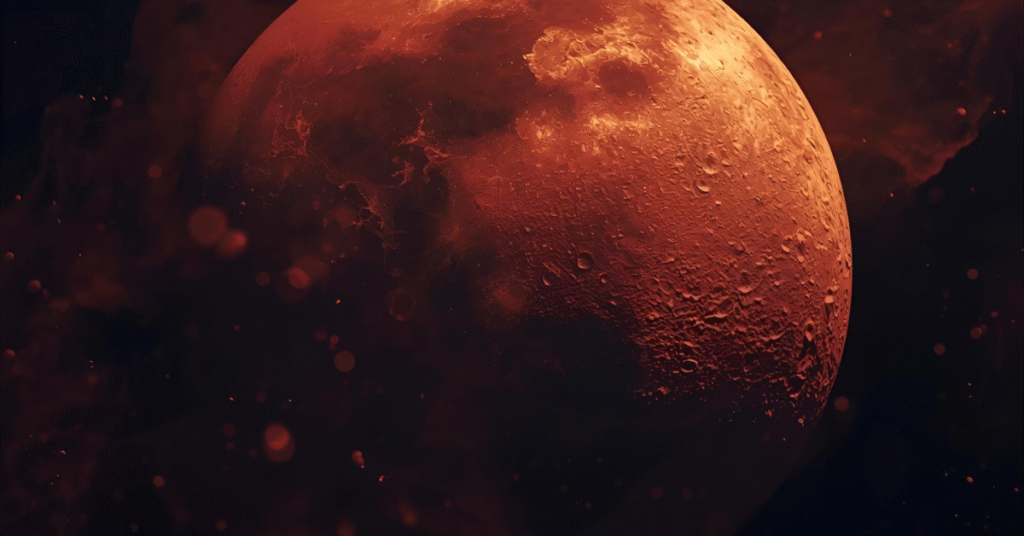
For centuries, the Moon has been seen as a cold, dry, and airless rock — an unchanging companion in our sky. But a strange discovery has shocked scientists: the Moon is rusting.
That’s right — something is causing iron on the lunar surface to oxidize, forming hematite, a type of rust. But here’s the twist: rust usually needs oxygen and water to form — and the Moon has neither in any significant quantity.
So, how can the Moon be rusting?
Discovery: Hematite on the Lunar Poles
In 2020, scientists analyzing data from ISRO’s Chandrayaan-1 orbiter — specifically using NASA’s Moon Mineralogy Mapper (M³) instrument — found unexpected signs of hematite at the Moon’s polar regions.
Hematite is an iron oxide (Fe₂O₃), and on Earth, it forms when iron reacts with oxygen and water. On Mars, for example, its widespread presence gives the Red Planet its distinctive hue.
But the Moon is rusting without the conditions that make rust possible here on Earth. So researchers were left with a major mystery: what is causing this oxidation?
Earth’s Oxygen: The Unlikely Culprit
The current leading theory points to an unlikely but scientifically fascinating cause: Earth’s oxygen.
As the Moon orbits Earth, it occasionally passes through a region known as Earth’s magnetotail — a magnetic extension on the night side of the planet formed by solar wind interacting with Earth’s magnetosphere.
During this phase:
- Oxygen from Earth’s upper atmosphere can hitch a ride along magnetic field lines.
- This oxygen may reach the Moon’s surface — especially near the poles — and react with iron in the soil.
- Simultaneously, the magnetotail blocks the solar wind, which normally delivers hydrogen that could neutralize oxidation. This creates a rare window where rusting can occur.
This means that the Moon is rusting in part because of a kind of “Earth wind” — a poetic twist of cosmic weather.
But What About Water?
Even if oxygen reaches the Moon, rust still requires water. While the Moon doesn’t have liquid water on its surface, it does have small amounts of water molecules bound in soil grains — especially near the poles.
How is this possible?
- Micrometeorites frequently hit the Moon, generating enough heat to briefly melt soil and release trapped water molecules.
- This momentary presence of water, combined with iron-rich rocks and oxygen from Earth, creates just enough of the right conditions for oxidation.
So yes — in short bursts and over very long timescales — the Moon is rusting.
Evidence on Both Sides of the Moon
Curiously, scientists also detected traces of rust on the far side of the Moon — the side that never faces Earth. This raises new questions:
- How could Earth’s oxygen reach the far side?
- Are there other oxidizing agents or processes at play?
- Could meteoritic water and solar wind chemistry be affecting more than we thought?
The presence of hematite on both near and far sides suggests that lunar chemistry is more dynamic and complex than previously believed. This discovery has cracked open a new area of lunar science that is still unfolding.
Why the Moon Rusting Matters
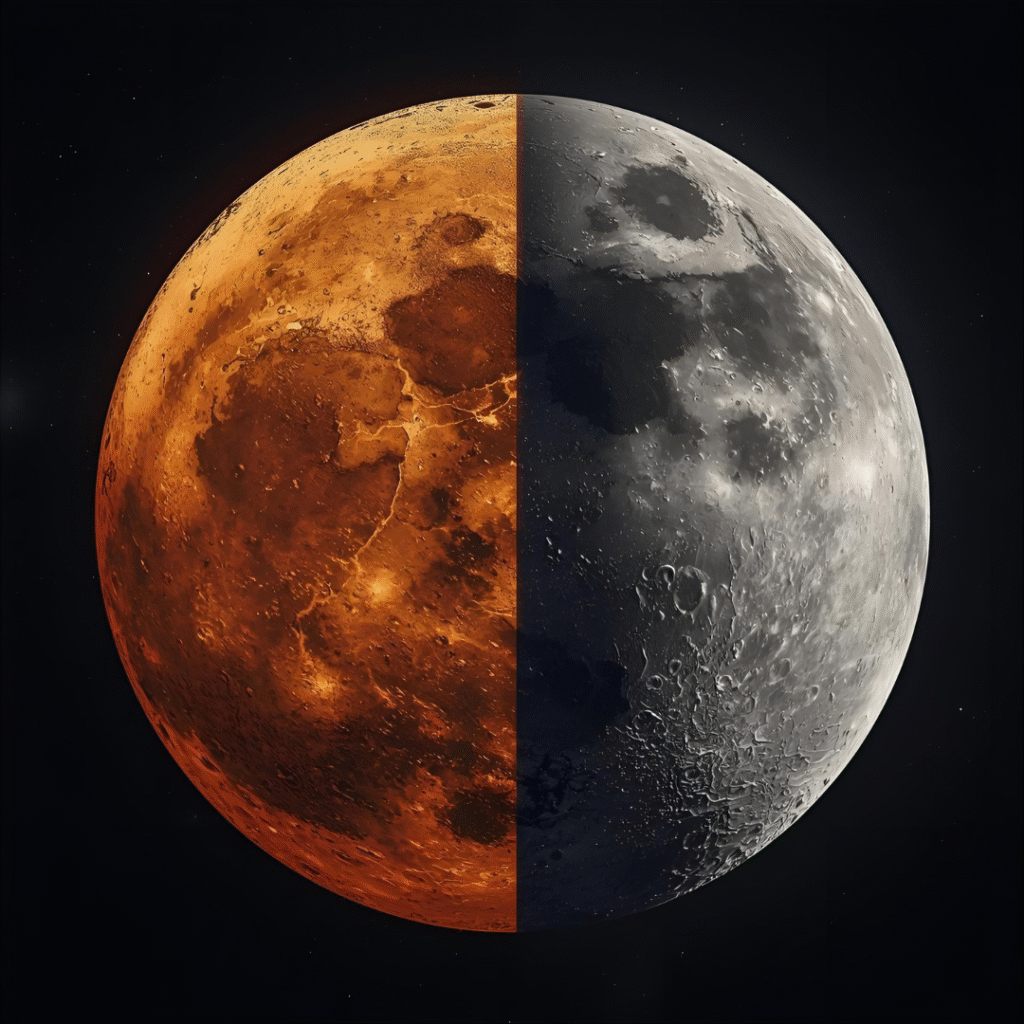
The fact that the Moon is rusting might sound like trivia — but it has deeper implications:
1. New Understanding of Earth-Moon Interaction
This phenomenon shows that Earth and the Moon exchange more than just gravitational forces — they also share atmospheric particles, even across space.
2. Clues About Water on the Moon
This adds to growing evidence that water — even in small amounts — exists on the Moon and plays a more active role than we once thought.
3. Implications for Future Lunar Missions
As NASA and private space companies prepare for long-term lunar missions (like Artemis), understanding surface chemistry is crucial for:
- Mining resources like water and metals
- Designing habitats and equipment that resist corrosion
- Planning safe and sustainable lunar exploration
4. Wider Impact on Planetary Science
If the Moon can rust in airless conditions, what does that say about other airless bodies like asteroids or moons around other planets? This could change how we interpret spectral data from deep space.
Final Thoughts: A Red-Stained Mystery in the Sky
The idea that the Moon is rusting forces us to rethink everything we thought we knew about our celestial neighbor. It reveals a hidden connection between Earth and the Moon that spans magnetic fields, solar winds, and even atomic particles.
It’s a reminder that space isn’t static — it’s alive with interactions, chemistry, and evolution.
So next time you look up at the Moon, consider this: somewhere near its poles, under layers of ancient dust, tiny patches of rust may be slowly spreading — silently painted by Earth’s breath across a timeless landscape.
For More Blogs go to trendings.

It’s very informative